
How Much Food Do You Need for a Lebanese Wedding Buffet?
A Lebanese buffet is one of the most generous catering options for a wedding. It also comes with one particular challenge: unlike a plated menu, it is not simply a matter of counting dishes — it’s about getting the right quantities and balance.
How much mezze should you plan for 100 guests? How much grilled meat per person? Do you need the same variety for 50 guests as you do for 200? These are the questions that come up at every reception — and the answers determine whether your buffet feels abundant or simply sufficient.
Here is our approach, based on over 30 years of Lebanese wedding receptions in Paris, to help you plan your wedding buffet without any unpleasant surprises.
Why a Lebanese Buffet Works So Well for Weddings
Lebanese cuisine is built around sharing. Its very structure — a variety of dishes placed at the centre of the table and shared among guests — naturally lends itself to a buffet, unlike cuisines that need to be adapted to this format.
Three key advantages for a wedding reception:
- It caters to different dietary needs. A large selection of mezze is vegetarian, and often vegan. Vegetarian guests won’t be left with just a side dish — they can enjoy a complete meal.
- It allows for last-minute changes. A buffet made up of a variety of dishes can accommodate an extra guest much more easily than a plated menu.
- It brings people together. A Lebanese buffet naturally creates movement and conversation between tables, adding to the atmosphere of the reception.
If you’re new to Lebanese cuisine, our guide to Lebanese mezze explores each dish in more detail.
How Much Food Should You Plan Per Person?
As a general rule, allow 700 to 800 g of food per person for a complete evening wedding buffet. Below this, the buffet may run out too quickly; above it, you risk ordering more food than your guests can eat.
This total is then divided between the different stages of the reception.
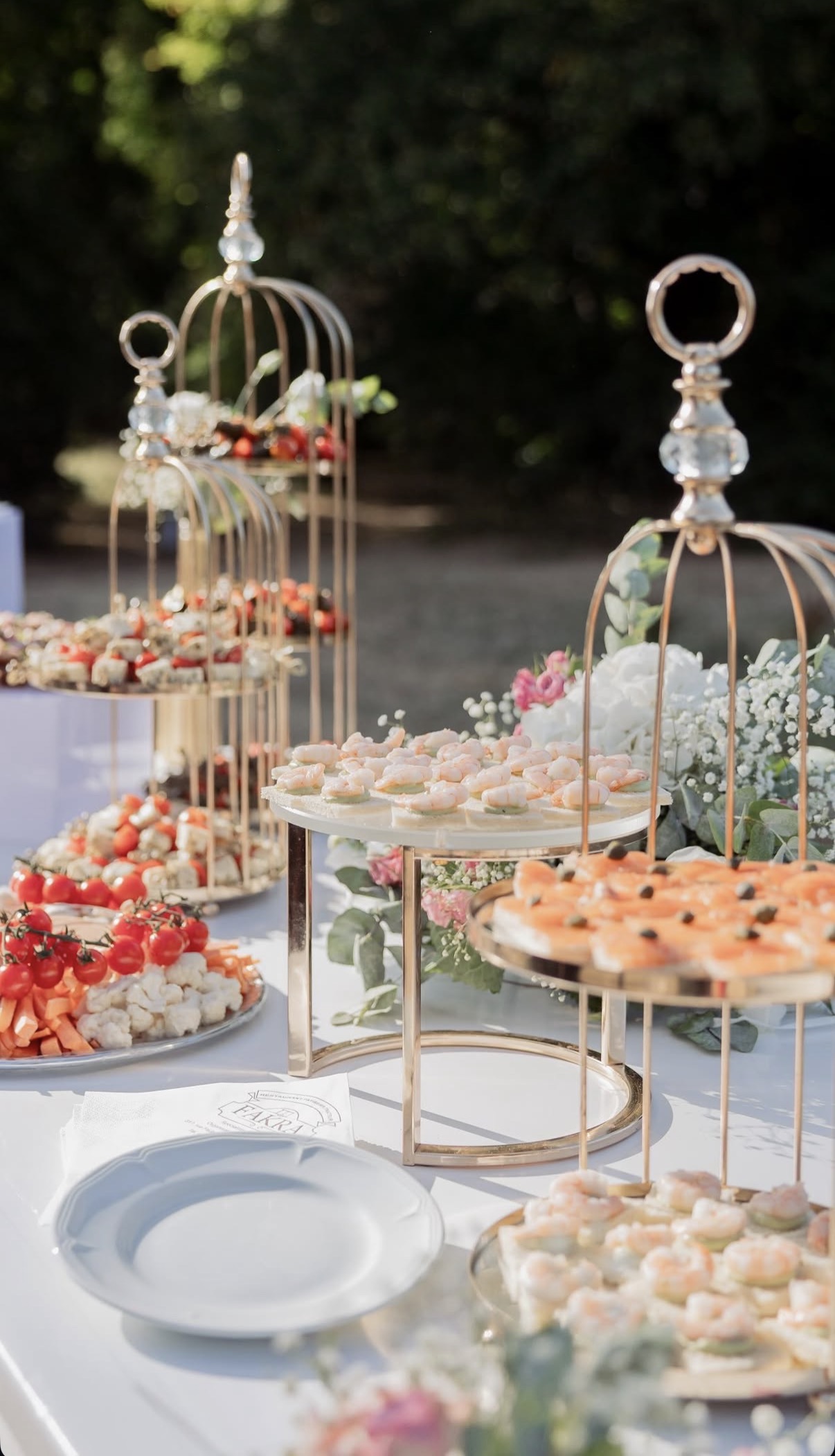
Welcome Cocktail
Allow 6 to 8 pieces per person for a one-hour cocktail, or 10 to 12 if the reception lasts longer or dinner is served late. Mini fatayers, sambousek, cheese pastries, mini falafels and skewers all work well for a standing reception.
One thing to keep in mind: if the cocktail lasts more than an hour and a half, your guests may already be quite full by the time they reach the main buffet. A shorter, generous welcome is better than a long cocktail that throws off the balance of the meal.
Mezze
Allow 250 to 300 g per person, spread across a variety of dishes. The key is not just the quantity, but the balance: around one third creamy dips such as hummus, moutabal and labneh; one third fresh salads such as taboulé and fattoush; and one third hot mezze such as falafel, kebbeh and sambousek.
A buffet made up entirely of creamy dips can quickly feel repetitive. It is the contrast between hot and cold, creamy and tangy, that creates a true sense of abundance.
Grilled Meats & Hot Dishes
Allow 200 to 250 g of raw meat per person, which comes to approximately 150 to 180 g once grilled. Three varieties are enough to suit a range of tastes: shish taouk (marinated chicken), kafta (minced beef and lamb with herbs) and shish kebab. Going beyond four varieties increases the cost without necessarily adding to the overall experience.
Always include a hot meat-free option — such as a vegetable dish, vegetable rice or a cheese-based preparation. This is one of the most common things to overlook, and one of the most noticeable for the guests concerned.
Side Dishes
Allow 80 to 100 g of uncooked rice per person, plus grilled vegetables and potatoes. These are among the most affordable parts of the buffet and also help create a generous, abundant spread, so don’t underestimate them.
Lebanese Bread
Allow 1.5 to 2 pieces of bread per person. This is one of the most consistently underestimated items. In a Lebanese meal, bread isn’t simply a side — it’s part of the way you eat.
Lebanese Pastries
Allow 3 to 4 pieces per person if pastries are the main dessert, or 2 to 3 if a wedding cake is also being served. Baklava, maamoul, knefeh and small pastries all work well on a buffet and can be prepared and arranged in advance.
Drinks
Allow 1 to 1.5 litres of non-alcoholic drinks per person for a full evening reception — more during the summer or for outdoor celebrations. Mint tea and Lebanese coffee are traditional finishing touches to a Lebanese reception.
Per-Person Guide
- Welcome cocktail: 6 to 8 pieces
- Mezze: 250 to 300 g
- Grilled meats: 200 to 250 g raw
- Rice and side dishes: 80 to 100 g uncooked
- Lebanese bread: 1.5 to 2 pieces
- Pastries: 3 to 4 pieces
- Non-alcoholic drinks: 1 to 1.5 L
Finally, add a 10% margin to your overall quantities. This allows for extra guests, children with adult-sized appetites and, of course, the guest who goes back for a third plate.
Building the Menu: The Four Stages of a Lebanese Reception
A Lebanese wedding buffet should be thought of as a progression, rather than simply a collection of dishes.
- The welcome. Hot and cold savoury bites served while guests are standing, during the drinks reception or while photos are being taken.
- The mezze. The heart of the buffet. This is when the table should look at its most abundant.
- The grilled meats and hot dishes. Ideally served in stages and replenished continuously rather than all placed out at once.
- The sweet finish. Lebanese pastries, seasonal fruit, coffee and mint tea, often served alongside the wedding cake.
Timing matters just as much as the menu itself. A buffet put out all at once can be eaten within 40 minutes and then look empty for the rest of the evening.
Adapting the Buffet to the Number of Guests
This is one of the most commonly misunderstood aspects of buffet planning. Quantities should increase with the number of guests, but the variety does not need to. A buffet for 200 guests does not need twice as many recipes as a buffet for 100 — it needs twice the quantity of the same recipes.
- Around 50 guests — 8 to 10 varieties of mezze, 3 grilled meats and 2 side dishes. One service point is sufficient.
- Around 100 guests — 10 to 12 varieties of mezze, 3 to 4 grilled meats and 3 side dishes. Plan for two service points to avoid queues.
- 200 guests and more — a maximum of 12 to 14 varieties of mezze, 4 grilled meats, 3 to 4 side dishes, and at least two identical buffet stations facing each other. Beyond 14 preparations, the additional logistical complexity can affect quality without adding much for guests.
A simple rule: from 80 guests onwards, add one service point for every additional 80 guests. The length of the queue will have a greater impact on the guest experience than the number of dishes on offer.
Buffet, Plated Service or a Combination?
All three formats work well with Lebanese cuisine, but they suit different types of receptions.
- Full buffet — the most convivial option and particularly well suited to large receptions. It encourages guests to mingle, but requires enough space and careful organisation.
- Plated service — more formal and gives greater control over quantities, but loses some of the sharing spirit that makes Lebanese dining so special.
- A combination of both — mezze served directly on the tables to share, followed by grilled meats served buffet-style. This is the format we most often recommend: it preserves the spirit of mezze while keeping the hot dishes flowing smoothly.
Halal, Vegetarian Options & Allergies: What to Plan Ahead
A Lebanese reception often brings together guests with different dietary requirements. Three points should be discussed in advance rather than on the day itself:
- Halal. At Fakra, all our meat is halal, without changing anything about the menu. This removes one thing from the list and means you can welcome everyone without having to create a separate menu.
- Vegetarian and vegan guests. Hummus, moutabal, taboulé, fattoush, vine leaves, falafel and foul make it easy to create a complete vegetarian buffet without preparing a separate meal. Simply make sure your vegan guests know which dishes contain dairy products.
- Allergens. Sesame (tahini) is widely used in Lebanese cuisine, while nuts are common in pastries and gluten is found in bulgur and bread. Discreet labels next to each dish can help avoid a stream of questions during the service.
The Most Common Mistakes
- Adding more recipes instead of increasing quantities. The first instinct when you’re worried about running out — and the most expensive one.
- Underestimating the bread. It tends to disappear twice as quickly as expected.
- Putting the entire buffet out at once. Staggered replenishment keeps the buffet looking abundant throughout the reception.
- Making the welcome cocktail too long. After an hour and a half, guests may already be too full for dinner.
- Forgetting a hot meat-free option. Mezze alone may not be enough to make a complete wedding meal for a vegetarian guest.
- Not planning for takeaway containers. At a Lebanese reception, leftovers often go home with guests. It’s part of the tradition, not simply a logistical detail.
When Should You Book Your Caterer?
- 10 to 12 months before — first enquiries and quote requests, especially for weddings between May and September.
- 6 to 8 months before — tasting and finalising the menu structure.
- 2 to 3 months before — final selection of dishes and a venue visit if the reception is taking place outside our locations.
- 15 days before — final guest count and dietary requirements.
Planning Your Reception with Maison Fakra
Since 1991, we have been catering Lebanese and Franco-Lebanese weddings in Paris and across the Île-de-France region. Our cuisine is fully halal and homemade, with two ways to celebrate:
- At Fakra — privately book one of our locations, with service and entertainment provided on site.
- At Your Place — buffets, grilled dishes and cocktail receptions delivered and set up at your chosen venue.
Every reception is different, so we work with you to build the menu and quantities around your guest count, venue and schedule.
Request a quote for your wedding
Frequently Asked Questions About Lebanese Wedding Buffets
How much food should I plan per person for a wedding buffet?
Allow 700 to 800 g of food per person across all categories for a complete wedding buffet, divided between the welcome cocktail, mezze, grilled meats, side dishes and pastries. Add a 10% margin for extra guests and second servings.
How many different mezze should I plan for 100 guests?
Plan for 10 to 12 varieties of mezze for 100 guests, with a balance of one third creamy dips, one third salads and one third hot mezze. For larger receptions, increase the quantities rather than the number of recipes — the variety should generally remain below around 14 preparations.
How much meat should I plan per person for wedding grills?
Allow 200 to 250 g of raw meat per person, which is approximately 150 to 180 g once grilled. Three varieties — shish taouk, kafta and shish kebab — are enough to offer a good range of flavours.
Is a Lebanese wedding buffet suitable for vegetarian guests?
Yes. A large part of Lebanese cuisine is vegetarian: hummus, moutabal, taboulé, fattoush, vine leaves, falafel and foul can all form part of a complete meal. We also recommend including at least one hot meat-free dish, as mezze alone may not be enough.
How far in advance should I book a wedding caterer?
For weddings between May and September, allow 10 to 12 months to secure your caterer, as this is the busiest period. For other times of the year, 6 to 8 months is generally sufficient. The final guest count should be confirmed around 15 days before the reception.
Is a buffet or plated service better for a Lebanese wedding?
A buffet naturally suits the sharing spirit of Lebanese cuisine and works particularly well for receptions of more than 80 guests. A combination of mezze shared directly at the tables followed by grilled meats served buffet-style offers a balance between conviviality and smooth service.